I’ve set my heart on reading the Bible to find Jesus in every chapter. I’ve discovered that my closeness to the Lord rises and falls with the time I devote to His Word. So searching for Him in its pages isn’t optional — it’s essential.
Not as a poetic exercise. Not as a theological flex. But as a way of reading Scripture the way it was meant to be read — as one unfolding revelation pointing to one Person.
Which is why reading through Leviticus can feel… daunting.
Let’s be honest. By the time you get to detailed instructions about kidneys, entrails, and fat portions, your devotional momentum can start to wobble. Measurements. Procedures. Repetition. Burn this. Remove that. Sprinkle here. Pour there.
It can feel technical. Ritualistic. Almost sterile. Borderline boring….
And then I got stuck.
Not on a dramatic verse.
Not on the Day of Atonement.
But on the repeated command to burn the fat.
Over and over again:
The fat belongs to the Lord.
Burn the fat on the altar.
It is a pleasing aroma to the Lord.
And I had to stop and ask myself:
What does this actually mean?
And where is Jesus in this?
Because if all Scripture points to Christ, then surely, even the fat is saying something.
And here is what settled into my spirit: there is absolutely nothing insignificant in Scripture. Every word was placed there by the Holy Spirit with intention. If it feels boring, it’s not because it lacks meaning — it’s because I haven’t yet seen what it’s pointing to.
In the sacrificial system laid out in Leviticus, when an animal was brought as a sin offering or peace offering, only certain parts were burned on the altar. Not the entire animal in most cases. Specifically, the fat — the fat around the vital organs, the kidneys, the lobe of the liver. Why the fat?
After a little reserach, it seems that in the ancient world, fat represented the richest, best, most inward portion. It was the protected part. The abundance. The choicest portion. In fact, Scripture says plainly:
“All the fat is the Lord’s.” (Leviticus 3:16)
The best part belonged to Him.
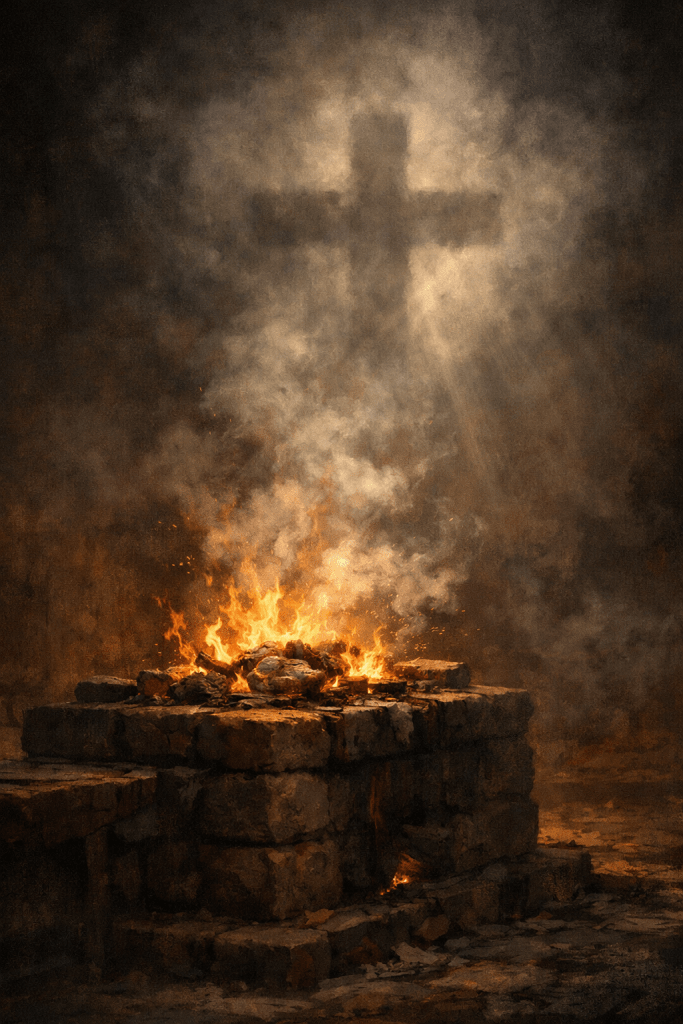
And it was placed on the altar and consumed by fire — a symbol of holiness, judgment, and complete consecration. The smoke rising was described as a pleasing aroma.
Something costly was consumed so that the sinner could walk away covered.
Now step forward to the cross.
The book of Hebrews tells us that the Levitical system was a shadow of something greater. A preview. A prophetic outline.
And then comes Jesus Christ.
Under the old covenant, only the best portion of the animal was burned — the inward richness.
At Calvary, Jesus did not offer a portion.
He offered Himself.
Not just His physical body, but His inward life. His strength. His obedience. His will. His spirit. He was not partially consumed on an altar — He was fully given.
Where Leviticus required the richest portion, God gave His richest treasure.
The direction flipped.
In Leviticus, humanity brings the best to approach a holy God.
At the cross, God gives His best to bring humanity near.
The fire that once symbolized judgment falling on an animal fell fully upon Christ. The innocent consumed so that the guilty could go free. But unlike the sacrifices that had to be repeated year after year, this offering was once for all.
Even the language echoes across the covenants. Paul writes that Christ gave Himself as a “fragrant offering.” That phrase is not accidental. It reaches back into Leviticus and pulls those altar images forward.
What once rose as smoke from burning fat now rises as the obedience of a suffering Savior.
And perhaps the most striking layer is this: the fat surrounded the vital organs — the inward parts. Sin also works inwardly. It is not merely external behavior but internal corruption.
The old covenant burned the inner portion symbolically.
The cross deals with the inner reality completely.
So the next time Leviticus feels slow, technical…or boring, pause. Ask the question. Look again.
Because buried in the procedural details of ancient sacrifices is a blazing prophetic picture of Calvary.
There is no filler in Scripture. No throwaway verses. No random ritual.
Even the fat speaks.
And if we read carefully enough, every chapter — yes, even Leviticus — will quietly but unmistakably whisper the name of Jesus.
 Tales from the Tangled Trail