Everyone dreams of being famous, right? I did too—until my big break landed me on the front page of the newspaper… mid-scream, mid-fall, mid-catapult off a modelling ramp. Spoiler alert: it wasn’t exactly the glamorous headline I had in mind.
Picture this: I’m 15 years old, already a towering 6 feet tall. My poor mother was beside herself. She had visions of me spending my teenage years as a human beanpole, permanently hunched over trying to look “normal height.” Desperate to fix this, she tried ballet when I was about seven. That ended quickly. The ballet teacher took one look at me and basically said, “Sorry, kid, you’re too tall. Try basketball.”
So fast forward a few years, my friend signs up for a modelling course, and my mother jumps on it like it’s the answer to all our prayers. After all, she’d been a model in her youth and was convinced that modelling would magically transform me into a swan with perfect posture. She went on and on about how, in her day, “deportment” was everything. They literally balanced books on their heads, shoulders back, gliding gracefully down the catwalk like floating angels.
The 80s, however, were a different story. Our instructor didn’t hand out books to balance—she just told us to “turn here, smile there, walk like you’re not about to trip.” And for some reason, I was the only student who needed constant reminders to put my shoulders back. Every five seconds it was, “Carol, shoulders!” Maybe I had subconsciously started slumping out of sheer rebellion—or maybe I was just allergic to good posture. Either way, it drove me nuts.
And then there was my other “issue.” According to Shirley, our long-suffering instructor, I just could not, for the life of me, stop singing. Every time we walked to the music, I was basically Julie Andrews twirling through the Alps in The Sound of Music. Shirley would hiss at me like a furious librarian: “Carol! Mouth closed!” But honestly, how was I supposed to resist? A good beat deserved backup vocals.
After weeks of training (and rebukes), graduation night finally arrived. We had to strut three routines: beachwear, daywear, and evening wear. And here’s the kicker—we had to supply our own outfits. Since money was a bit tight, my mother dusted off a relic I didn’t even know she owned: a sewing machine. To this day, I suspect it had been hiding in a cupboard since the 1960s.
Let’s just say the results were… memorable.
First up: my beachwear outfit. A knickerbocker set. Yes, knickerbockers. Blue with white frills everywhere—neckline, sleeves, pant legs. Honestly, I looked like Little Lord Fauntleroy goes to Miami. But hey, I wore it with all the dignity a 15-year-old could muster.
Next came “daywear.” My mother had hacked a long dress pattern into a mini-dress with an uneven hemline. It was less “fashion” and more “DIY upholstery project gone rogue.” But compared to the knickerbockers, it was practically Chanel.
Finally, evening wear. My mother had run out of time and surrendered to reality, so she took me to Scott’s, the fancy dress shop in town. I scored a frilly white number that made me feel like Cindy Crawford on prom night. My confidence skyrocketed—I was owning that runway.
Until… disaster struck.
I was halfway through my final turn, absolutely basking in the glory of my moment, when I caught Shirley on the sidelines, gesturing wildly like she was landing a plane and mouthing the words:
“STOP. SINGING!!!!”
My heart sank. In my horror at committing the cardinal sin of the runway strut, I forgot the whole walking in heels part. Next thing I knew, I was airborne—catapulting sideways off the ramp (which, I swear, was a good three feet off the ground). I nearly flattened some poor dad in the front row.
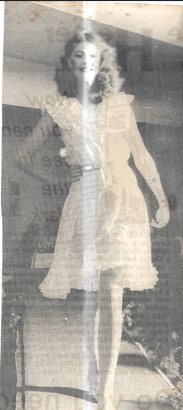
And of course—that’s when the photographer snapped the shot. Me, mid-“silent” scream, arms flailing, ruffles flying. And where did this masterpiece end up? Smack on the front page of the local Northglen News. Not the society pages, not even the classifieds—the front page.
Really???
And so, that was my brush with fame—front-page glory, immortalized not as a glamorous model, but as the girl who sang her way right off the catwalk.
Moral of the story? Be careful what you wish for. Everyone wants their name in lights… I just didn’t realize mine would be in bold print under the headline: “Teen Model Takes a Tumble.”
Turns out fame isn’t all it’s cracked up to be—sometimes it’s just a bruised knee and an even more bruised ego.
A clipping from the front page of the Northglen News in 1982 moments after spotting my fuming modelling instructor and falling off the ramp…
It was my friend Anne-Marie’s bridal shower, and I was officially on duty. She had called me earlier in the week with a rather desperate plea—please look after her at the shower. Now, this wasn’t your average “don’t let me spill wine on my dress” kind of request. No, Anne-Marie was about to enter the lion’s den.
She was marrying Richard, a lawyer in the shipping industry, much like herself. As an English barrister dealing with high-stakes shipping insurance, her stress levels were through the roof. In fact, both she and Richard had taken to calming drugs just to survive their relentless workloads. Add to that the monumental task of planning a wedding, and you had one very tightly wound bride-to-be.
Now, Richard’s family? Oh, they were ex-Rhodesians (from what was now Zimbabwe), and if I’d learned anything, it was this—these country folk could drink. And I don’t mean a casual “let’s sip some champagne” kind of drinking. No, they drank like it was an Olympic sport and they were going for gold.
To make matters even more interesting, Richard was a very large man. We’re talking “could probably bench press a small car” levels of big. Anne-Marie, on the other hand, was tiny. The contrast between them was both adorable and slightly comedic. But the real danger that night? Richard’s three sisters, who were hell-bent on making sure Anne-Marie was as slaughtered as humanly possible.
I had a bad feeling about this…
The evening began at a charming Italian restaurant in Durban’s social hotspot, Florida Road. It was a delightful night filled with laughter, conversation, watching Anne-Marie open gifts, and indulging in delicious Italian cuisine.
After dessert, I could sense the sisters were gearing up to take the evening to the next level. They started ordering shooters, enthusiastically insisting that Anne-Marie join in. She shot me a desperate look—a silent plea for an escape plan.
Thinking quickly, I loudly suggested we move the party to a nearby club where we could dance and drink at the same time. The group loved the idea, and we all agreed to meet at the entrance. My real plan, however, was to get Anne-Marie inside the club and steer her straight toward the exit—a strategy I executed flawlessly.
On the drive home, I had to pull over several times to let Anne-Marie recover from the effects of the alcohol she’d already had too much of. By the time we got back, we wasted no time changing into our pajamas and putting the kettle on for some much-needed coffee.
Just as we settled into the lounge with our steaming mugs, we noticed headlights in the driveway. Anne-Marie squinted at them, confused—until recognition dawned on her face. It was her soon-to-be brother-in-law, Richard’s best man.
The plan for the night was for Richard’s stag party to be held on the same evening as Anne-Marie’s bridal shower. Since heavy drinking was expected, Richard had arranged to stay at his brother-in-law’s place, as driving all the way to Umdloti Beach would be out of the question.
That’s why Anne-Marie was surprised to see his car in the driveway. Worried that something had happened, she rushed outside. As she reached the car, Richard’s brother-in-law stumbled out, swaying and slurring his words. “All Richard wanted was to come home,” he mumbled. We were too confused and shaken to even process how this man, in such a state of inebriation, had managed to survive the drive back to Umdloti Beach. The thought hit us only later—how easily he could have killed himself, or worse, taken the lives of innocent strangers on that winding coastal road.
Anne-Marie peered into the backseat and found Richard lying there, completely unresponsive. She opened the door and gently told him he was home and could get out now, but he didn’t move. Eventually, his brother-in-law had to climb into the car, grab him by the arms, and drag him out. Given Richard’s size, this was no easy feat, but after some effort, he stirred just enough to steady himself against the car.
Even in the dim light from the house, it was obvious—Richard was the drunkest man I had ever seen, and I had seen plenty! As the only sober person there, I suggested we get him to a bathroom to see if he would vomit. I had heard stories of people choking on their own vomit in their sleep, and I wasn’t about to let that happen.
With his arms draped over our shoulders, we half-carried, half-dragged him to the bathroom. He collapsed next to the toilet, rested his head on the seat, and shut his eyes as if ready to pass out again. That’s when I wondered—how exactly do you make a drunk man vomit? There was no way I was sticking my fingers down his throat.
We tried to keep him awake, hoping he would throw up on his own, but it quickly became clear that this was a losing battle. I then suggested we move him to bed—but on his stomach—so that if he did vomit, he wouldn’t choke.
Getting him off the bathroom floor was yet another ordeal, but eventually, we managed to lift him up and walk him a few unsteady steps to the bed. The moment we let go, he collapsed face-down, sprawled diagonally across the mattress. At least this way, I thought, if he did throw up, he wouldn’t ruin Anne-Marie’s entire bed.
We left him there and went back to the lounge, making a cup of coffee for his brother-in-law while we chatted, waiting for him to sober up enough to drive home. As we watched his tail lights disappear down the road, a sudden, thunderous crash shattered the silence. It came from the bedroom.
Heart pounding, we ran inside to find Richard sprawled on the floor, wedged between the bed and the large wooden side table he and Anne-Marie had bought in Bali and shipped home. We rushed to lift him, trying to rouse him, but this time, he wouldn’t wake up. If he had passed out again, there was no way we’d be able to get him back onto the bed.
We managed to shift him just enough so that his head rested against the wall, slightly elevated. In my mind, this was better than having him lie flat—at least if he vomited, he wouldn’t choke. It was a stiflingly hot evening, but Anne-Marie insisted on draping a light duvet over him. Then, exhausted and uneasy, she suggested we share the guest bed and let Richard sleep it off.
Neither of us slept well. I had a nightmare about a funeral and woke up at dawn, drenched in sweat. Anne-Marie was already awake, clutching her head, groggy from a hangover. She suggested we get up and make some tea. As I boiled the water, I suggested she take a glass of water to Richard. She agreed it was a good idea.
I listened as she walked into the bedroom, coaxing him awake. Moments later, just as I was about to pour the tea, she returned. Her face was pale.
“Something’s wrong with Richard,” she said, her voice unsteady. “He won’t wake up.”
Dread coiled in my stomach as I followed her to the bedroom. The moment I saw him, a wave of nausea hit me. The sight was horrifying—Richard was so lifeless, so still, that all the blood had drained to the lower half of his elevated face. The top half of his skin was an ashen gray, while the lower half was stained with dark, blood-red blotches.
I must have gasped, because Anne-Marie immediately panicked. She grabbed Richard’s body, shaking him violently. “Wake up! Wake up!” she screamed.
“Call an ambulance!” she shrieked, her voice raw with desperation.
We didn’t have 911 in South Africa, and for the life of me, I couldn’t remember the emergency number. My mind was spinning, my hands trembling. I could hear Anne-Marie sobbing, pleading with Richard’s lifeless body.
Panic swallowed me whole. I had never seen a dead body before, let alone someone I cared about. I needed to escape. I bolted for the door, fumbled with the lock, and wrenched it open. I ran through the garden, reaching for the gate, desperate to get away from the nightmare unfolding inside.
Then I heard Anne-Marie’s screams—raw, guttural wails that sent a fresh wave of terror through me. I turned and ran back into the house.
By the time I reached her, she was on the phone, shouting at the emergency operator. “He’s not breathing!” she cried. I realized she was in complete denial, frantically trying to save a man who was already gone.
The operator instructed her to check if something was lodged in his throat. With a wild desperation, she straddled his chest, clawing at his rigor-mortised lips, trying to pry them open. “I can’t!” she sobbed. “His mouth won’t open!”
The operator gave another command: “Lift his legs.”
Anne-Marie scrambled off him and turned to me, her eyes wild with urgency. “Lift his legs!” she ordered.
I hesitated. I wanted to scream at her, to make her see reason. But she was beyond logic. Her grief was madness, and I was powerless against it.
“LIFT HIS LEGS!” she screamed.
Shaking, I grabbed Richard’s ankles and lifted. His body moved like a stiff ironing board—rigid, unyielding, lifeless. Anne-Marie hurried to the suitcase she had been packing for their honeymoon—just a week away—and shoved it beneath his feet. Then she climbed back on top of him, still desperately trying to pry his mouth open.
Tears streamed down her face as she sobbed into the phone. “I still can’t see anything! He won’t breathe!”
That’s when I snapped.
“HE’S DEAD!!!” I screamed, my voice breaking under the weight of reality.
Anne-Marie collapsed into wails, her body shaking with grief. I yanked the phone from her trembling hands and told the operator, “Her fiancé is dead. I’m sure of it.”
The voice on the other end was calm, gentle. “An ambulance and the police are on their way. Please stay on the line.”
Then there was a knock at the door. For a brief moment, I thought it was the emergency responders—but it was the neighbor, drawn by the screams. His face fell when I told him the news. He went into the bedroom, gently pulled Anne-Marie off the corpse of the man she loved, and led her to the lounge.
I followed, gripping the phone like a lifeline, thankful for any excuse not to go back into that room.
The whole time, one thought gnawed at me—this was my fault. My worst fear had come true. Richard had drowned in his own vomit, and I had failed to save him.
And that’s how I stayed for the better part of the day—frozen on the couch, gripping Anne-Marie’s hand as though letting go might make it all more real.
The neighbor took charge, asking for the numbers of Richard’s family. I listened numbly as he made the calls, his voice hushed but steady, breaking the worst news anyone could deliver.
We sat in a daze until the first car pulled into the driveway. The moment Anne-Marie saw them, she tore from the house, wailing with such raw grief that I thought my heart might shatter. This was surreal—like watching a nightmare play out while trapped inside it.
Richard’s sisters and their husbands hurried past me, eyes glazed with shock, and went straight to the bedroom where he lay lifeless on the floor. They took Anne-Marie with them, and the sounds that followed—deep, animal sobs, choked gasps, desperate whispers of his name—were almost too much to bear.
Eventually, they came out, pale and trembling, ready to whisk Anne-Marie away. But the police had arrived, and she had to give her statement before she could leave.
I was asked to stay behind, to recount what had happened to the emergency workers and later to the police. Reliving that horror, again and again, felt like some twisted form of punishment. Dark thoughts clawed at me: Was this my fault? Should I have done more to keep him from choking? Would they blame me? Prosecute me?
After Anne-Marie had sobbed out her broken, stumbling account of the night, Richard’s family insisted on taking her home. She needed clothes—we were both still in our pajamas. One of his sisters turned to me, her face red and swollen, and asked if I could get some clothes from Anne-Marie’s cupboard.
I wanted to scream, to run out of that house and never look back. The idea of stepping back into that room—where the weight of death lingered, suffocating—made my skin crawl. But I couldn’t refuse. So, with my heart pounding in my ears, I forced myself down the hall.
I kept my eyes locked on the cupboard, refusing to glance at the bed or the cold, still body beside it. The suitcase she’d used to prop up his feet was lying near the open wardrobe. I dragged it over and swept handfuls of clothes inside—anything I could reach—then dug for some underwear with shaking hands.
I backed out of the room as quickly as I could, gripping the suitcase like a lifeline. The atmosphere in there was indescribable, as if the very walls had soaked in death and despair.
When I stepped into the lounge again, Anne-Marie was clutching Richard’s sister, her sobs quieter but no less heartbreaking. I handed over the suitcase and stood there, hollow, not knowing where to look or what to feel—only that I would never forget the way that room had felt, thick with the memory of a life suddenly and brutally cut short.
By around 3 p.m., I was finally told I could leave. The house still swarmed with police, as if it had become a crime scene. In many ways, it had.
I threw on the clothes from the night before, eager to escape the suffocating weight of tragedy, and slipped out as quickly as I could. The drive home was a blur, my mind heavy with the grief of my poor friend, who had just lost the love of her life. A deep, aching loneliness settled over me. I felt broken.
Several weeks after the funeral—held on what should have been Richard and Anne-Marie’s wedding day—I received a call from their next-door neighbor, who, by an odd coincidence, was also a doctor. That Saturday morning, I had confessed to him my deepest fear: that Richard had died because of me, that I had failed him while he drowned in his own vomit. Now, he was calling to share the coroner’s report. Richard had suffered an enormous coronary, one so catastrophic that not even seven heart surgeons working together could have saved him. The combination of alcohol and antidepressants had triggered it.
Hearing this brought a strange relief—I hadn’t failed him; there had been nothing I could have done. But that relief was quickly overshadowed by a chilling realization: when he fell off the bed, it wasn’t just a collapse—it was a testament to the sheer force of the coronary, strong enough to lift a comatose man who had been lying diagonally across the mattress and hurl him to the floor. Every desperate effort I had made to lift him, to keep him upright, had been an attempt to move a body already claimed by death. The weight of that thought, of having tried in vain to save a life that could not be saved, sank into me like a stone.
That night etched into me a truth I could never shake: alcohol and stress are a deadly partnership. Richard’s death was not only about how much he drank; it was about the weight he had been carrying long before the first glass was poured. Both he and Anne-Marie were professionals stretched so thin by their careers that they lived on calming medication just to keep going. Their wedding, which should have been a joy, had become one more layer of expectation pressing them down. In that state, alcohol was not harmless fun—it was fuel on an already raging fire.
I had always thought of drinking as a way to let off steam, to loosen up when life felt too tight. But what I saw that night forced me to confront a darker reality: when stress has already weakened the body and frayed the mind, alcohol does not relax—it destabilizes. It numbs awareness, dulls instinct, and steals the body’s last line of defense. Richard wasn’t the first person to use alcohol as an escape, but he was the first in my world whose escape became permanent.
It left me with a lingering question I carried for years: how many of us live in the same cycle—too stressed to cope, too desperate not to find some way out—and how close are we, without even knowing it, to the same edge? Stress will always demand an outlet. The world offers alcohol, pills, distractions, and busyness, but they are only shadows of relief. They cover pain for a moment, but they never heal it.
What I’ve since learned is that there is a healthier outlet, one that doesn’t mask or destroy but restores. It is a life anchored in Jesus Christ. In Him, the pressure of this world does not crush, and the weight of stress finds release. Where alcohol numbs for a night, His presence gives peace that endures. Where the world offers escape, He offers rest. Richard’s story became a sobering reminder to me that the only true refuge from stress isn’t found in a bottle, but in the arms of the One who promised, “Come to Me, all you who are weary and burdened, and I will give you rest.”
Duncan had gotten dressed and said he’d meet me down at the hotel’s fancy restaurant. Now, ordinarily, I’d be thrilled—because I love food. Especially good food. But this time? I took my sweet time getting ready. Not because I wanted to impress Duncan, but because I was still fuming over the “oops, only one suite left” situation.
I wasn’t exactly leaping at the chance to head downstairs. Something in my gut told me this evening was going to be weird—and not the fun, spontaneous kind of weird. More like the “I’m about to be emotionally ambushed” kind. If I could’ve buried my head in the minibar like an ostrich and pretended none of this was happening, I would’ve.
But instead, I took my time getting dressed—part stalling tactic, part emotional armor. I wasn’t going to waltz in all sunshine and sparkles like I hadn’t just been wedged into a suite-sharing situation I never signed up for. No way. I decided to go with a look I like to call disengaged but dazzling. Think: hostage chic, but with lip gloss.
By the time I floated into the restaurant, I was composed—at least on the outside. On the inside? Still rage-simmering with a hint of “how-do-I-escape-this-trip-with-my-sanity?”
We had just ordered our first course when I decided—against all better judgment—to have a glass of wine. Maybe it would help smooth over my mood. Maybe it would just help me sit through another night of Duncan talking about wood grain finishes.
But then—just as I took that first hesitant sip—he leaned in.
“I’ve really loved our time together,” he said, eyes soft and serious. “I’m in love with you. I’ve been in love with you since you worked for me. This trip… was so I could finally tell you. I want to marry you.”
Cue internal collapse. My heart froze. My jaw didn’t drop (I have some dignity), but my stomach absolutely did a backflip.
Why was it always the men I had zero interest in who insisted on loving me with Olympic-level intensity?
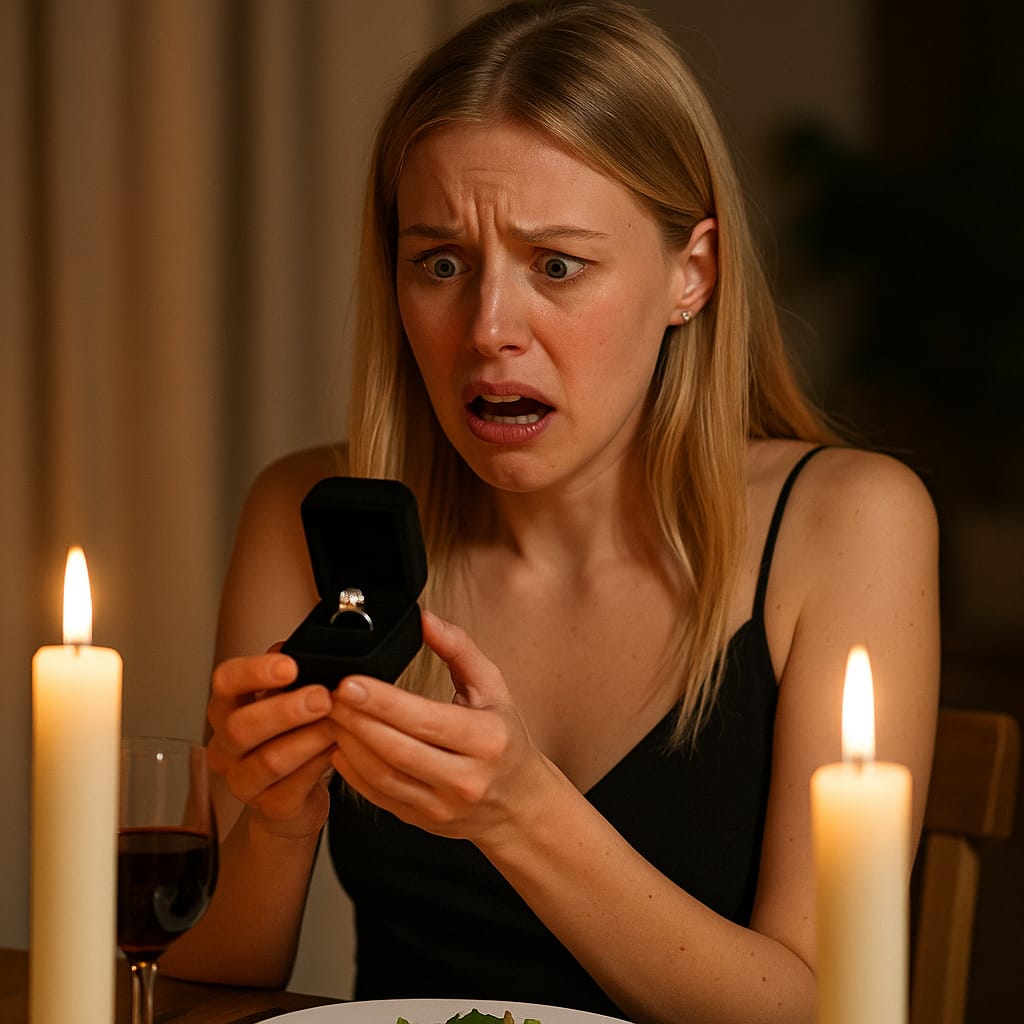
Then—as if this couldn’t get worse—he pulled out a little black velvet box.
Oh, sweet mercy.
He didn’t even get down on one knee. Just handed it over. Like a contract. Or an unsolicited invoice for emotional damage.
Inside? A diamond. A very large, very sparkly, very innocent-looking diamond. Too bad it was giving me a full-body anxiety rash.
Panic!
I was speechless. Not in the happy, teary-eyed, “oh my word this is the best day of my life” kind of way. More like the stunned, wide-eyed, “I might faint into this bread roll” kind of way. And I could only pray Duncan wasn’t mistaking my silence for the romantic kind of overwhelmed.
His lips were still moving—definitely still talking. Something about love… forever… destiny, maybe? I honestly couldn’t tell. All I could focus on was the twinkling diamond glaring at me from inside its velvet cell like a sparkly little accomplice to this crime of confusion.
Then came the question: “Are you going to say something?”
Oh, Duncan. I wish I had.
To this day, I have no memory of my actual response. I think it was something weak and non-committal like, “Wow… I’m so honored you feel this way.” Which, let’s be real, is the international code for: “Absolutely not, but I’m too polite to say it yet.”
That’s when full-blown panic took over. I began listing every possible reason why I would make a terrible wife. Surely, surely, logic would win the day.
I was too emotionally unavailable. I didn’t know what I wanted in life. I still had commitment issues… with gym memberships, let alone marriage.
But Duncan? Unfazed.
He had a counter for every excuse I gave—calm, confident, relentless. It suddenly made perfect sense why he was such a successful lawyer. I was basically presenting Exhibit A for “This Is Not Going to Happen,” and he was expertly cross-examining it into oblivion.
Meanwhile, I was spiraling.
How on earth was I going to turn this down without nuking my future business prospects… and possibly a shot at international travel and financial salvation?
Then the food arrived.
But while Duncan tucked in with the joy of a man who’d just proposed and assumed it went well, I could barely chew. Every bite felt like it came with a side of anxiety. I washed it all down with more wine—hoping it might give me either the courage to be honest, or a nap I wouldn’t wake up from until we were back in Durban.
He, of course, misread my wine consumption as a celebration. Me? I was mourning my exit strategy.
Couch Couture and Midnight Madness
Eventually, sometime between the cheesecake and my third glass of liquid denial, Duncan asked the inevitable: “So… do you have an answer?”
Panic. I stalled. “I’ll need some time to think about it,” I said, in the most non-committal, conflict-avoiding tone I could manage.
A flicker of disappointment passed over his face—followed, interestingly, by what looked like relief. I hadn’t said yes (praise be), but I hadn’t said no either. Just… a diplomatic holding pattern. He could still hope, and I could still breathe.
But then came the real challenge: returning to the suite.
It was still too early to turn in, but Duncan announced cheerfully that he was calling it a night. “Oh, okay! Good night!” I chirped—maybe just a bit too brightly—as I made a dramatic beeline for the miniature couch like it was a perfectly reasonable sleeping arrangement and not a glorified footstool.
Now, let’s remember—this was the 1990s in South Africa. We didn’t have cable or streaming or anything remotely entertaining past 10 p.m. What we did have was SABC, our one sad little channel. On Saturday nights, the movie would end promptly at 10, followed by a string of solemn religious programming (think: pipe organs and softly spoken sermons), and then—if you were still awake—the grand finale: a test pattern and the national anthem. That was it. Entertainment closed for the night like a tuck shop on a public holiday.
Midnight hit. Exhaustion hit harder.
And that couch? It had all the comfort of a shoebox lined with regret.
I weighed my options. Cling to this glorified bench and wake up with spinal trauma? Or admit defeat and slide silently into the enormous king-sized bed?
I chose survival.
So, I layered every item of clothing in my suitcase like a human onion, crept across the room, and eased into the very far edge of the mattress—as in, one accidental roll and I’d be on the floor. Mission: do not touch Duncan.
I must’ve passed out instantly.
Because the next thing I knew, I was under attack.
Snore Wars : The Final Deterrent
I jolted awake to find Duncan looming over me, wielding a pillow like a weapon and hissing: “Carol! Will you STOP SNORING?!”
Apparently, the allergies I’d been ignoring all day had blossomed into a full-blown, symphonic, soul-shaking snore-fest. Duncan was livid.
Whether it was the noise, or the shock of seeing me lying there—bundled like a human burrito in every item of clothing I owned—it clearly spelled out what I hadn’t managed to say over dinner: this was never going to be a love story.
He stormed off without a word, stomped onto the balcony, lit a cigarette, and glared at the horizon like it had personally offended him. Bare-chested. Sleep shorts. Smouldering with betrayal.
I did feel bad. Sort of. But mostly? Immensely relieved. I no longer needed a carefully crafted “it’s not you, it’s me” monologue. My nasal passages had done the heavy lifting. My snoring had spoken the unspoken.
Needless to say, the pot of gold I thought Duncan represented turned out to be an old rusted tin can with holes in the bottom.
The drive home? Painfully silent. So silent, you could hear my regret shifting awkwardly in the back seat.
What was I supposed to say? “Sorry my nasal passages betrayed you”?
And the more the kilometres rolled by, the more irritated I became. Had this whole “business venture” just been a romantic ruse? A bait-and-switch wrapped in handcrafted wooden bowls?
I hadn’t seen his kindness as anything but… well, kindness. And sure, maybe I’d laughed at his jokes or smiled politely over dinner—but that’s not a binding contract. It’s basic social grace.
By the time we pulled up to my car in Umkomaas, I couldn’t decide if I felt more guilty for not feeling guilty, or just mad that the whole awkward circus had even happened.
Either way, the fairy tale was over. Not with a glass slipper, but with a snort and a slam of a car door.
On Reflection….
I never heard from Duncan again.
And honestly, I didn’t expect to. He was a good man—kind, respectful, and genuine—and while I did miss him, I couldn’t bring myself to reach out. I didn’t want to give him false hope or rub salt into what was likely still a pretty raw wound.
The whole episode didn’t leave me feeling triumphant. Quite the opposite, actually. It chipped away at my already-fragile self-esteem. I’d hurt someone who didn’t deserve it—however unintentionally—and that truth stuck with me. What stung even more was the uncomfortable realization that I had been this close to a better future. Stability. Travel. A solid, kind-hearted man. But I let it all go… because, if I’m being brutally honest, he didn’t look like Brad Pitt. Turns out, I was that shallow.
The whole Duncan chapter became one of those cringe-worthy “what was I thinking” moments I often take to God in prayer. Thankfully, in His endless grace, He has led me into a spacious place—a life where He truly has turned all things for good (Romans 8:28). The shame, the regret, the bad choices? He’s repurposed it all.
And while I still have a suitcase full of questionable decisions and terrifying detours to share, I tell these stories not to glamorize the mess—but to hopefully make you laugh, and more importantly, to warn younger girls: Get healed. Get whole. Don’t waste years wandering down dead-end roads like I did.
Just when I thought the only thing in my future was toast and tears in my pyjamas, Duncan called with a business proposition.
Not the pyramid scheme kind, thankfully. No, Duncan had a vision—to export handcrafted wooden bowls made by women artisans in the Transkei. These weren’t just bowls; they were intracately carved by hand from the beautiful Wild Olive Tree, and Duncan believed they’d be a hit in European homeware boutiques. It wasn’t a terrible idea. In fact, it was the first thing that had given me a flicker of hope since I crash-landed back in Durban with heartbreak, no job, and a champagne lifestyle I could no longer afford on a ginger ale budget.
It wasn’t just the potential income that drew me in—it was the chance to travel, to start something new. Things were finally looking up.
The Business Trip Proposal
Duncan suggested we take a weekend trip to the Transkei to scout for suppliers and see the business potential firsthand. I was all in—I’d never been to the Transkei, and any excuse to leave town sounded like an adventure. He offered to pick me up en route, since I’d be in Umkomaas on Friday night. Technically, Umkomaas was wildly out of the way, but I wasn’t about to skip the party. One of my school friends lived there with her fiancé, and he had a tribe of handsome, single friends. None of them showed even a flicker of interest in me, but that wasn’t going to stop me from putting in the effort. “Perfect,” I said with breezy confidence. “I’ll be ready.”
How Not to Arrive on a Business Trip
To say I overdid it would be an understatement. I drank far too much, spent a good portion of the night making best friends with the toilet, and got maybe an hour of sleep—if we’re being generous. By the time Duncan pulled up the next morning, bright-eyed and full of road trip enthusiasm, I looked like a cautionary tale in a health textbook. I hadn’t eaten. I hadn’t showered. I hadn’t even brushed the disappointment off my soul.
Duncan, bless him, was thrilled to see me. Beaming, chatty, completely unaware that I was one sip of water away from disaster. I told him—somewhat sheepishly—about my wild night. He was kind about it, even chuckled and said I could nap on the drive.
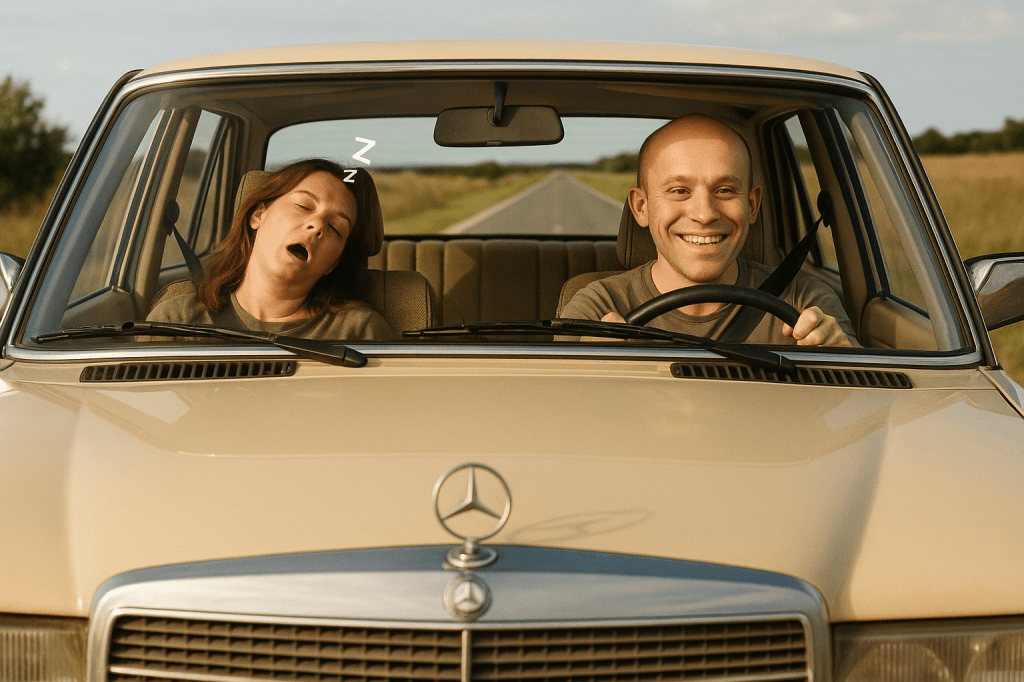
Nap? Please. I blacked out like someone had tranquilized me. Mouth wide open, head tilted back, full-on drool situation. By the time I resurfaced from unconsciousness, we were pulling into our first hotel—The Royal Swazi. A very fancy, very majestic place that I could not have cared less about because all I could think was: Is lunch still being served? I was dizzy, dehydrated, and still had last night’s mascara flaking down my face like a dusty shame trail. I probably looked like I’d been dragged through a nightclub and then rolled into a bush. But hey—business trip, right?
Trinkets, Tiredness & the Toasted Agenda🥴
Once I’d inhaled something resembling lunch and had a moment to resuscitate my soul, Duncan and I set out on our grand mission: to find authentic, handcrafted bowls made by the famed Transkei women carvers.
What we found instead? A whole lot of wooden rhinos, giraffes, and generic tourist trinkets. Not a bowl—or woman artisan—in sight. It was like going on a hunt for buried treasure and coming up with themed fridge magnets.
Still clinging to the hope that tomorrow would be more fruitful, we returned to the hotel. That evening, Duncan suggested we meet at the bar for a drink. I physically recoiled. After the previous night’s wine-fueled meltdown, the thought of alcohol made my internal organs shudder. I ordered soda water. He looked a little disappointed, but frankly, he wasn’t someone I needed to dazzle. He was my former boss—not my Tinder match—and ideally, my soon-to-be business partner who’d lead me to financial freedom (and maybe a European buying trip or two).
I managed to endure one polite drink and dinner, though I can’t recall much of the conversation. Duncan was in full storytelling mode, but exhaustion was steamrolling me. My brain had officially checked out. I excused myself, went straight to my room, and collapsed.
I slept like the dead. No dreams. No stirring. Just blackout recovery mode. So deeply asleep, in fact, that I completely missed our very ambitious 8 a.m. breakfast meeting. Duncan had to call my room. I shot out of bed like I’d been electrocuted, did a 90-second beauty triage in the mirror, and flew down to breakfast—apologizing so profusely that I almost offered to buy the hotel a new clock.
Bowls, Business…and One Bed?
After we checked out of the rather regal Royal Swazi, Duncan and I hit the road for our next stop—a hotel on the opposite end of Swaziland. We drove for hours, still scanning the roadside for those elusive bowl artisans, but there was a noticeable shift. Duncan no longer seemed too bothered by the lack of handmade goods. In fact, he looked… relaxed. Almost like the bowls were suddenly optional.
I tried steering the conversation back to business—suppliers, logistics, pricing strategy—and to my relief, he responded with some solid ideas. That little entrepreneurial spark reignited. Maybe this trip wasn’t a complete disaster. Maybe I was on the verge of turning my financial ship around after all.
Four hours (and zero bowls) later, we arrived at the next hotel.
Then came the twist.
At check-in, the receptionist gave us that smile. You know the one: “I’m about to ruin your day, but I’m going to do it politely.”
“I’m so sorry… we’re overbooked. We only have one room available—but it is a suite.”
My internal alarm bells started clanging. I turned to Duncan with a hopeful, please-tell-me-this-isn’t-happening expression. He grinned like a kid on Christmas morning. “Oh, you don’t mind, do you?”
Reader—I minded. I REALLY minded.
Still, my ever-optimistic brain tried to soothe me. It’s a suite, I reasoned. There will be a couch. You’ll sleep on the couch. No problem. Except… the couch was one of those decorative ones. You know the kind—designed to look expensive, not to be used. It was about the length of a yoga mat and looked like it would buckle under the weight of a handbag.
Oh well, I told myself. I’ll make it work. This is just a blip on the business journey.
We dropped our bags and Duncan suggested heading to the pool for a drink. Finally—something safe. No surprises. No intimacy. Just water, maybe food, and hopefully a moment to recalibrate. The afternoon passed uneventfully, with more business talk and less bowl talk. I let myself get hopeful again.
Then came dinner. And that’s when the wheels really started to fall off.
Coming up next in the final episode: A proposal, a panic, and my desperate attempt to keep a straight face while my internal monologue screamed. 🙃

 Tales from the Tangled Trail